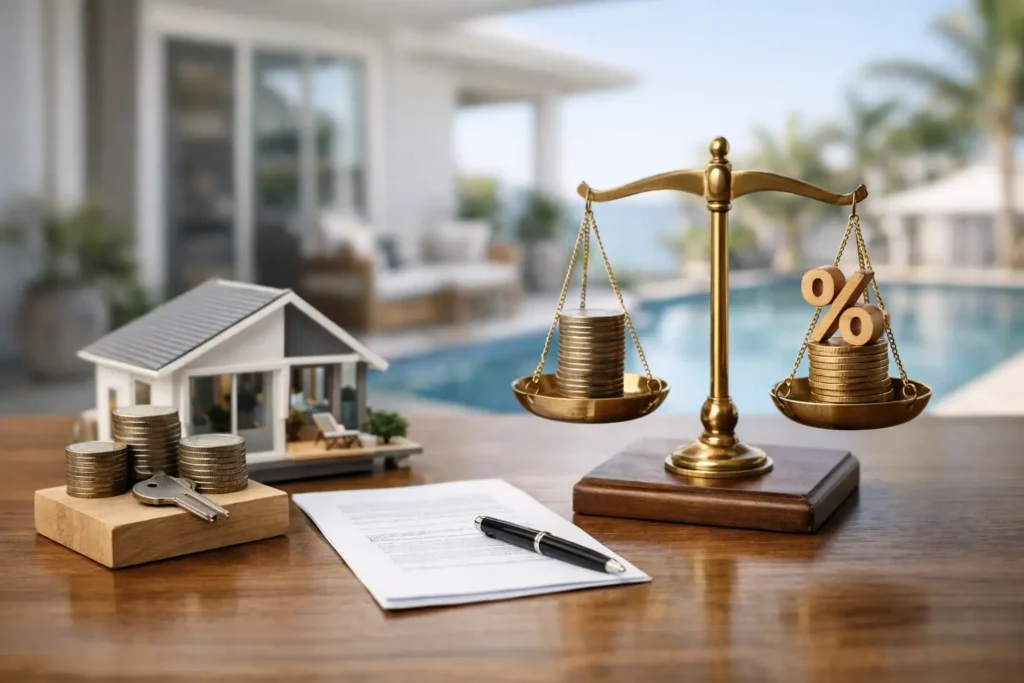
A $20,000 difference in your sale price can make a far bigger impact than a small difference in an agent’s fee. That is the real issue behind fixed commission versus percentage commission. Sellers deserve a clear answer on what they will pay, but they also need to understand whether the chosen fee structure supports the strongest possible campaign, negotiation and final result.
There is no single commission model that suits every Sunshine Coast property. A straightforward unit sale in a tightly held building is different from selling an acreage home, a waterfront property or a family home where buyer competition can add serious value. The right question is not simply, “Which fee is cheaper?” It is, “Which arrangement gives me the best chance of being ahead after every cost is paid?”
Fixed Commission Versus Percentage Commission: The Difference
A fixed commission is an agreed dollar amount paid to the selling agent, regardless of the final sale price. For example, an agent may charge $15,000 plus GST whether the property sells for $900,000 or $1,050,000. The main appeal is certainty. You know the commission amount from the outset and can budget accordingly.
A percentage commission is calculated as a percentage of the final sale price. If the agreed rate is 2 per cent plus GST, the commission rises or falls with the price achieved. Sell for more and the agent earns more. Sell for less and the commission reduces.
Both structures can be legitimate and both can be fair. What matters is the complete agreement: the commission, marketing costs, GST, any administration charges, the length of the agency authority and what happens if the property is withdrawn or sold after the agreement ends. A low headline figure can look attractive until the finer details appear.
Why the Cheapest Fee Is Not Always the Best Deal
Commission is a cost, and sensible sellers should scrutinise it. But reducing the conversation to the lowest fee can be expensive if it leads to a weaker campaign or a rushed negotiation.
Consider two scenarios. Agent A offers a fixed fee of $14,000 and secures a sale at $1,000,000. Agent B charges a higher percentage-based fee that totals $19,000 but creates competition and negotiates a sale at $1,040,000. Even after the extra $5,000 in commission, the seller is $35,000 better off before considering other selling costs.
That does not mean a percentage model automatically produces a better sale price. Great agents are motivated by reputation, referrals, repeat business and professional standards as much as by commission. It does mean that a fee should be assessed alongside the agent’s ability to price accurately, present the home well, communicate with buyers and hold firm when an offer arrives.
A cheap commission cannot recover money left on the table through poor buyer management.
The Case for a Fixed Commission
Fixed commission can work well when the likely sale price is clear and the scope of work is relatively predictable. Sellers who value cost certainty often prefer knowing exactly what they will pay from day one.
It can also be appealing at the upper end of the market, where a standard percentage can become a substantial dollar amount. In those cases, a fixed fee may represent good value, provided the agent is still committing to a full campaign and not cutting corners on service, buyer follow-up or negotiation.
The potential downside is perception. Some sellers worry that once the fixed fee is agreed, there is less financial incentive for the agent to pursue an additional $20,000 or $50,000. That concern is understandable, although it should not be the sole test of an agent’s commitment. A respected local agent has plenty to lose by accepting an easy result: future listings, referrals and a hard-earned reputation.
The practical issue is whether the fixed fee is matched by clear performance expectations. Ask how the agent will generate competition, how often they will report back, who will conduct inspections and how they will handle multiple offers. If those answers are vague, the commission structure is the least of your concerns.
The Case for Percentage Commission
Percentage commission directly links the agent’s payment to the final sale price. For many sellers, that alignment feels logical. If the agent negotiates a stronger result, both parties benefit.
This structure can make particular sense where the eventual sale price has a wide range. A property with exceptional views, development potential, acreage, a unique renovation or strong buyer demand may be difficult to value precisely before the campaign begins. If the agent can create competitive tension, a percentage model shares some of the upside.
The downside is less certainty. If your property sells above expectations, the commission will increase. Sellers should not be surprised by that at settlement. Request a written example of the commission payable at several possible sale prices, including GST, so you can see the full dollar impact before signing.
A percentage rate also needs context. A lower rate does not necessarily mean lower total costs if other charges are added, and a higher rate is not automatically unreasonable if it reflects a genuinely high-touch service and proven sales performance. Compare like with like.
Tiered or incentive-based commission
Some agencies offer a tiered structure. The agent may receive one rate up to an agreed benchmark, then a higher rate on the amount achieved above it. For example, the commission might be 1.8 per cent up to $1 million and a higher percentage on any amount above that figure.
When set properly, this can be a fair middle ground. It gives the seller a known benchmark while rewarding the agent for exceeding it. The benchmark must be realistic, not a number selected simply to make the agreement look appealing. It should be based on evidence from comparable sales, active competition and current buyer enquiry.
What to Compare Before You Sign
A commission quote is only useful when you know exactly what it includes. Before appointing an agent, ask for the agreement to be explained in plain English and compare the total likely cost, not just the rate or fixed number.
Check whether the quoted commission includes GST, whether marketing is separate, and whether photography, copywriting, floorplans, signage, online advertising and database promotion are included or charged individually. Confirm the authority period and whether any commission may be payable if you sell privately to a buyer introduced during the campaign.
You should also ask what happens if the home does not sell. Are marketing expenses payable regardless? Can the campaign be adjusted without starting again? Is there a clear plan for feedback, pricing review and re-engaging buyers who inspected but did not initially offer?
These are not awkward questions. A professional agent should welcome them. Selling a home is a major financial decision, and no-bullshit clarity is better than a commission conversation full of assumptions.
Choose the Agent Before You Choose the Fee Model
The fee model matters, but the person managing the sale matters more. Your agent controls the day-to-day work that influences the result: positioning the property, qualifying enquiry, inspecting buyers, following up, gathering feedback, managing offers and negotiating when emotions are high.
For Sunshine Coast sellers, local knowledge adds real value. Buyer expectations can shift sharply between Buderim, Maroochydore, Mooloolaba, Caloundra, hinterland locations and acreage pockets. An agent who understands where buyers are coming from, what they are comparing and which features they will pay a premium for is better placed to set a strategy that attracts serious attention.
Look for evidence rather than promises. Ask about recent comparable sales, average days on market, the marketing approach recommended for your property and the agent’s role in the negotiations. Reviews and referrals are useful, but so is the quality of the agent’s answers when you ask difficult questions.
A good agent will not promise an unrealistic price simply to win the listing. They will explain the opportunity, the risks and the plan to create the strongest possible outcome.
A Better Way to Make the Decision
Start by asking each agent to estimate the total commission payable at three sale prices: a conservative result, an expected result and an exceptional result. Then place those figures beside their proposed marketing plan, local sales evidence and negotiation strategy.
If a fixed commission offers certainty and the agent has a clear, credible plan to protect your price, it may be the right choice. If a percentage or tiered model better reflects the potential upside of your property and you are confident in the agent’s ability to pursue it, that can be equally sensible.
Do not let a small commission saving become the reason you accept less for your home. Choose the arrangement you understand, the marketing you believe in and the agent you trust to fight for the best price from first inspection through to settlement.
About the Author
Rudi du Preez is one of the Sunshine Coast's top real estate agents and director of du Preez Property Group at Amber Werchon Property. A 25-year local with 250+ properties sold, specialising in Buderim, Nambour and the Sunshine Coast hinterland.
Get a Free Appraisal